



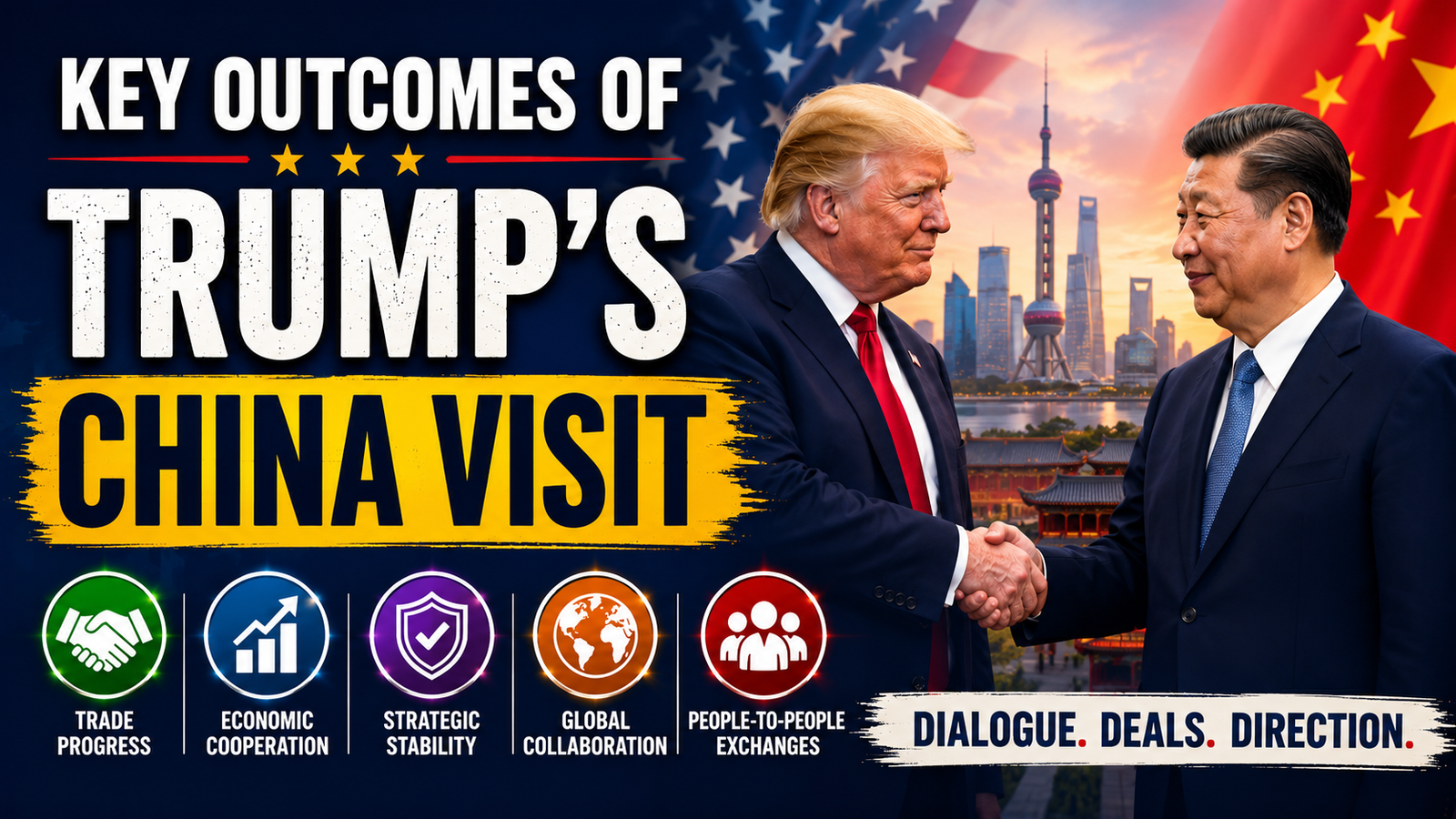
For the first time in nearly nine years, a sitting U.S. president set foot in Beijing. Donald Trump’s two-day state visit to China on May 14–15, 2026 was one of the most anticipated diplomatic events of the decade — a meeting between the world’s two largest economies at a moment of extraordinary global tension. From trade deals and semiconductor access to the Iran war and the ever-present shadow of Taiwan, the Trump–Xi summit carried stakes that extend far beyond Washington and Beijing.
How It All Came Together
The groundwork for this visit was laid quietly but deliberately. Trump and Xi first met during the Busan Summit in South Korea in October 2025, where Trump announced his intention to visit China. The trip was originally planned for early April 2026, but was postponed due to the ongoing conflict in Iran. When the White House formally announced the May 12–15 dates, the world started paying close attention.
Trump arrived in Beijing with one of the most high-powered business delegations ever assembled for a presidential trip — Elon Musk of Tesla, Tim Cook of Apple, Jensen Huang of Nvidia, Larry Fink of BlackRock, and Boeing CEO Kelly Ortberg were all part of the entourage. Their presence alone signaled that commerce, technology, and the future of AI were at the heart of these conversations.
What Came Out of the Summit
The immediate outcomes were a mix of real progress and unmet expectations — a reflection of just how complicated the U.S.–China relationship has become.
Boeing Gets a Lifeline. The single biggest concrete announcement was China’s agreement to purchase 200 Boeing aircraft — the first major commercial airplane order from China in nearly a decade. The last comparable deal was struck during Trump’s 2017 Beijing visit, when China ordered 300 planes. While the new order fell short of the 500 planes the industry had hoped for, it is a meaningful signal that the two countries are willing to do business again.
NVIDIA’s H200 Access Opens — Partially. In a significant reversal of years of bipartisan export restrictions, the U.S. Commerce Department approved ten Chinese tech giants — including Alibaba, Tencent, ByteDance, JD.com, and Lenovo — to purchase Nvidia’s H200 chips. However, not a single chip had actually shipped by the time Trump left Beijing, and rare earth exports from China were still running well below pre-restriction levels. The framework exists; the delivery is still pending.
Agricultural Trade Commitments. Both sides agreed on Chinese purchases of American farm goods, with corn and soybeans front and center — a relief for American farmers who have suffered during years of trade war disruptions.
A Guiding Framework for Three Years. Perhaps most importantly, the two nations agreed to build what official Chinese readouts called a “constructive China–U.S. relationship of strategic stability” — a diplomatic framework intended to govern the relationship for the next three years and beyond.
Xi Invited to the White House. Trump invited President Xi Jinping and his wife Peng Liyuan to visit the United States on September 24, 2026, setting the stage for continued dialogue and potentially deeper deals.
The Geopolitical Picture
The summit was defined as much by what was not resolved as by what was. The Iran war loomed over every conversation. The U.S. continues to blockade the Strait of Hormuz, and China — the world’s largest consumer of Iranian oil — has deep economic stakes in the conflict’s resolution. China’s foreign minister issued a pointed statement calling for an end to the war, while Beijing stopped well short of actively pressuring Tehran.
On Taiwan, Xi delivered a direct warning: “The Taiwan question is the most important issue in China–U.S. relations. If mishandled, the two nations could collide or even come into conflict.” No major shift in U.S. policy on Taiwan was announced, and Taiwan itself was watching the summit with considerable anxiety, worried that Trump might trade away American commitments in exchange for economic wins.
At a broader level, analysts from CSIS and Brookings described the summit not as a breakthrough, but as a stabilization — a conscious effort by both powers to prevent further deterioration rather than solve long-standing disputes. That may sound modest, but in a world rattled by the Iran war, tariff battles, and AI competition, stability between Washington and Beijing is itself a form of progress.
Why This Matters for the World
The significance of this summit extends far beyond the two nations at the table. The U.S., China, and EU together account for roughly 60 percent of global GDP. When Washington and Beijing are fighting, the entire world feels it — in higher prices, disrupted supply chains, and rising geopolitical risk. When they talk, markets breathe easier.
Xi captured this sentiment himself at the state dinner, declaring that China’s “great rejuvenation” and Trump’s “Make America Great Again” can go hand in hand — and that the relationship “concerns the interests of over 8 billion people in the world.” For once, the rhetoric matched the stakes.
The reopening of Boeing sales matters to aviation workers in Seattle and to airlines in Asia. The easing of chip restrictions matters to AI developers in Bangalore, London, and São Paulo. The agricultural deals matter to farmers in the American Midwest and consumers across Southeast Asia. And a reduction in U.S.–China friction — however partial — reduces the risk of the kind of superpower miscalculation that could drag the entire planet into a catastrophic conflict.
A Relationship Stabilized, Not Solved
There were no grand breakthroughs in Beijing. The deep disagreements over Taiwan, technology, and geopolitical alignment were papered over with warm toasts and photo opportunities outside the Great Hall of the People. Both sides left having gotten something, but not everything.
Yet that is, perhaps, the right expectation for a relationship this complex. The two largest economies in the world cannot resolve decades of rivalry in 36 hours. What they can do — and what this summit achieved — is demonstrate a shared preference for engagement over confrontation. After years of trade wars, export battles, and Cold War-style rhetoric, the simple act of a U.S. president and China’s top leader sitting across from each other and agreeing to keep talking is not nothing.
It is, in fact, a foundation. And the world badly needs one.


