



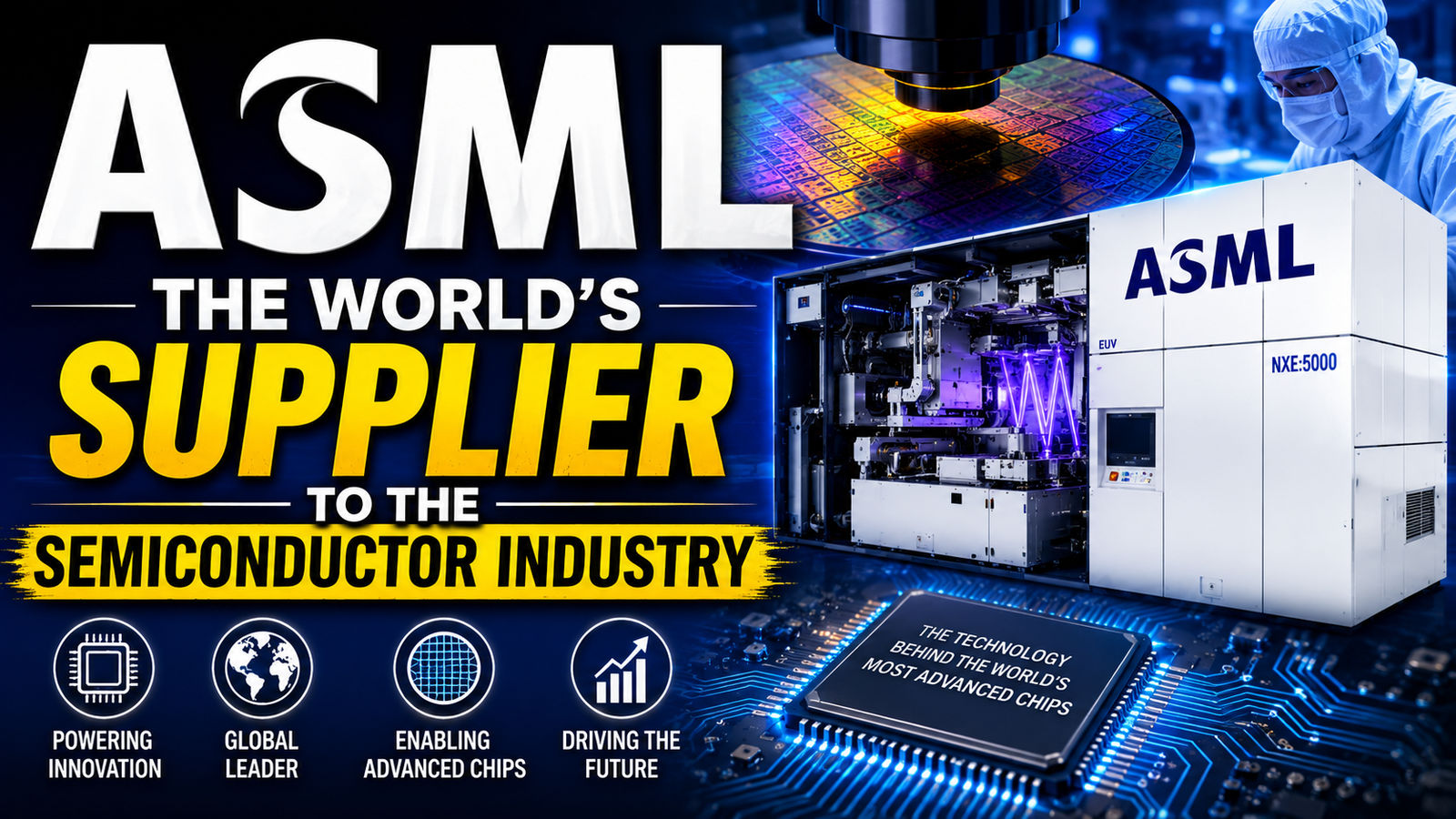
In today’s digital world, almost everything depends on semiconductors. Smartphones, laptops, electric vehicles, artificial intelligence systems, satellites, medical devices, and even modern household appliances all require advanced computer chips. Behind this enormous global industry stands one company that most ordinary consumers have never heard of: ASML.
ASML is not a chipmaker like Intel, TSMC, or Samsung Electronics. Instead, it builds the highly advanced machines that chipmakers need to manufacture semiconductors. Without ASML, the modern semiconductor industry would struggle to produce the world’s most powerful chips.


The Birth of ASML
ASML was founded in 1984 in the Netherlands as a joint venture between Philips and ASM International. Originally called “Advanced Semiconductor Materials Lithography,” the company started as a small technology venture working on lithography systems for chip manufacturing.
At the time, the semiconductor equipment market was dominated by Japanese companies such as Nikon and Canon. Few people expected ASML to become the most important company in the semiconductor supply chain.


Over the decades, however, ASML focused heavily on research, engineering, and partnerships. That long-term investment eventually gave the company a technological lead that competitors could not match.
What Does ASML Actually Make?
ASML manufactures photolithography machines. These machines are used to “print” microscopic circuit patterns onto silicon wafers, which later become semiconductor chips.
Lithography is one of the most critical steps in chip manufacturing. The smaller and more precise the patterns are, the more powerful and energy-efficient the chips become.


ASML’s machines use light to transfer complex chip designs onto wafers at nanometer-level precision. This process allows companies to manufacture billions of tiny transistors on a single chip.
The company produces two major categories of systems:
- DUV (Deep Ultraviolet) lithography machines
- EUV (Extreme Ultraviolet) lithography machines
Among these, EUV technology made ASML globally dominant.
The Importance of EUV Technology


EUV lithography is considered one of the greatest engineering achievements in modern technology. It uses extremely short wavelengths of light—13.5 nanometers—to print incredibly tiny chip structures.
This technology enables the production of advanced chips used in:
- Artificial intelligence systems
- Data centers
- Smartphones
- Autonomous vehicles
- Military systems
- Cloud computing
- Advanced graphics processors
ASML is currently the only company in the world capable of producing EUV lithography systems at commercial scale.
That means every leading chipmaker depends on ASML.
Without ASML’s EUV machines:
- Apple could not manufacture advanced iPhone processors.
- NVIDIA would struggle to produce AI GPUs.
- Intel and Samsung Electronics could not compete in cutting-edge semiconductor manufacturing.
Why ASML Has No Real Competitor
Many experts describe ASML as one of the most important monopolies in the modern technology world.
There are several reasons why competitors have failed to catch up.
1. Extreme Technological Complexity
An EUV machine is one of the most complex machines ever built by humans. Some systems contain:
- Over 100,000 individual parts
- Precision mirrors smoother than any manufactured surface on Earth
- Advanced laser systems
- Vacuum chambers
- Nano-level positioning technology
Each machine can weigh more than 180 tons and cost over $200 million.

2. Decades of Research Investment
ASML spent billions of euros over nearly two decades developing EUV technology.
Many competitors abandoned EUV research because it was too expensive and technically difficult. ASML continued investing while others stepped away.
3. Global Supplier Network
ASML depends on thousands of specialized suppliers worldwide. One of the most important partners is Carl Zeiss AG, which produces the ultra-precise mirrors required for EUV systems.
No single company can easily replicate this global ecosystem.
4. Massive Entry Barrier
Building a rival EUV ecosystem would require:
- Tens of billions of dollars
- Decades of R&D
- Specialized physics expertise
- Global supply chain coordination
Very few companies or countries can attempt such a project.
ASML and the Global Chip Supply Chain
ASML sits at the center of the semiconductor supply chain. Chip designers create chip architectures, foundries manufacture them, but ASML provides the essential equipment that makes advanced manufacturing possible.
Major customers include:
These companies use ASML systems to manufacture chips at 7nm, 5nm, 3nm, and future 2nm technology nodes.
This makes ASML a critical “bottleneck” company. If ASML stops delivering machines, advanced chip production across the world slows down.
Geopolitical Importance
ASML is no longer just a technology company; it has become strategically important in global politics.
Countries now view semiconductor manufacturing as a matter of national security. Advanced chips are essential for:
- Artificial intelligence
- Defense systems
- Supercomputers
- Telecommunications
- Cybersecurity
Because ASML controls the most advanced lithography technology, governments closely monitor exports of its machines.
The United States and European governments have imposed restrictions on certain advanced semiconductor exports to China. This has made ASML central to the global technology competition between major powers.
ASML’s Role in the AI Revolution
The rise of artificial intelligence has increased global demand for advanced semiconductors. AI models require enormous computing power, and that computing power depends on high-performance chips.
Companies such as:
- OpenAI
- Microsoft
- Meta
all rely indirectly on ASML because the AI chips powering their systems are manufactured using ASML lithography machines.
This is why analysts often call ASML the “backbone” or “hidden king” of the AI era.
The Future of ASML
ASML is already developing the next generation of lithography technology known as High-NA EUV. These systems will allow even smaller and more powerful chips to be manufactured.
The company continues investing heavily in innovation as demand for semiconductors grows worldwide.
With AI, robotics, electric vehicles, quantum computing, and smart devices expanding rapidly, the world’s dependence on semiconductors will only increase. And as long as advanced chips are needed, ASML will remain one of the most critical companies in global technology.
Conclusion
ASML’s journey from a small Dutch startup to the world’s most important semiconductor equipment company is one of the greatest success stories in modern industrial history.
The company does not manufacture chips itself, yet it powers nearly every advanced semiconductor produced today. Its EUV lithography systems have become essential to the future of computing, artificial intelligence, and global technological progress.
In many ways, ASML is the invisible engine behind the digital age. Without its machines, the modern semiconductor industry—and much of today’s technology-driven world—would not function at its current level.


