



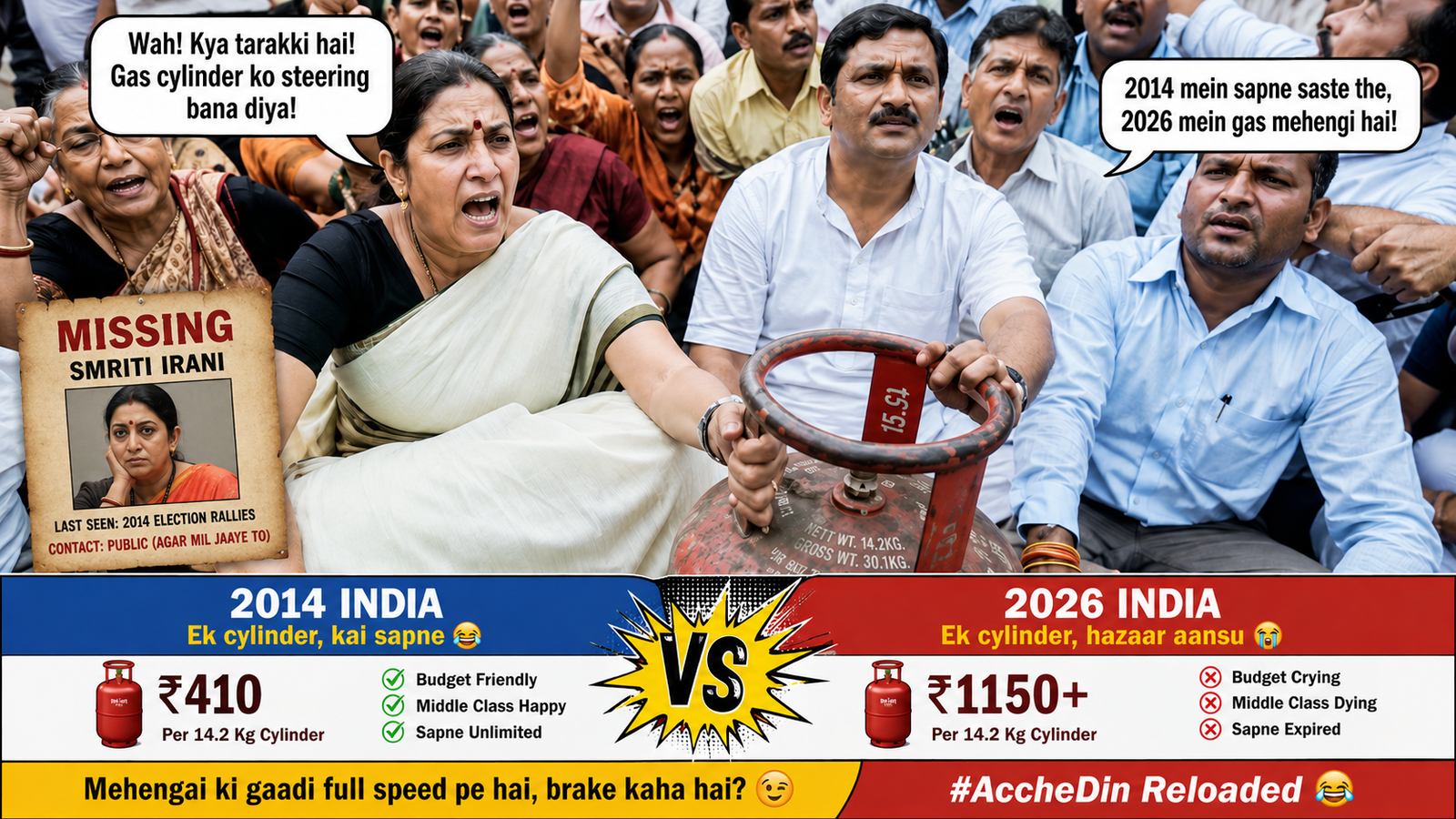
There was a time when a hike in LPG cylinder prices would trigger fiery protests, press conferences, and political speeches. Cameras would zoom in on leaders holding empty gas cylinders, shouting slogans and accusing the government of making life difficult for common families.
Among the prominent faces during earlier LPG price protests was BJP leader and former Union Minister Smriti Irani. Her speeches on rising cooking gas prices often became national headlines. But in 2026, as LPG prices remain a burden for millions of households, many people are asking a simple question:
Where is Smriti Irani now?
The Great LPG Protest Vanishing Act
The irony is difficult to ignore.
When the opposition was in power, rising LPG prices were often described as an attack on poor and middle-class families. A few hundred rupees increase in cylinder prices was enough to trigger protests, television debates, and political campaigns.
Today, LPG prices have crossed levels that many lower and middle-income families find difficult to afford. Yet, the streets are largely silent.
No dramatic gas-cylinder marches.
No major nationwide protests.
No daily television debates.
And no familiar pictures of politicians carrying cylinders on their shoulders.
It almost feels like India’s LPG protests have gone on an extended vacation.
Smriti Irani Is Not Missing—Just Not Protesting
Contrary to social media speculation, Smriti Irani has not disappeared from public life. She has continued participating in public events, media appearances, literary programmes, and social engagements in recent months.
However, she has not been visibly leading protests on LPG price hikes, despite being one of the most recognisable political voices on the issue in previous years. This contrast has naturally become a subject of political criticism and online satire.
After all, politics has an interesting relationship with inflation:
When your opponents are in power, inflation becomes a national emergency. When your own side governs, it often becomes an international challenge caused by global events.
Why Are LPG Prices Still High?
The government has repeatedly pointed to several factors:
- Global crude oil price fluctuations.
- Geopolitical tensions and conflicts affecting energy markets.
- Higher import costs.
- Rupee depreciation against the US dollar.
- Supply-chain disruptions.
These reasons are economically valid to an extent. India imports a significant portion of its energy requirements, making domestic fuel prices vulnerable to global developments.
However, for ordinary citizens, the explanation does not reduce the monthly expense.
A homemaker buying a cylinder does not calculate Brent crude prices or geopolitical risks. She calculates whether she can still afford groceries after paying for cooking gas.
The Subsidy Question
The reduction and limitation of LPG subsidies have become another major concern.
Under schemes like the Pradhan Mantri Ujjwala Yojana, millions of poor households received LPG connections. The programme was widely praised for improving women’s health and reducing dependence on traditional cooking fuels.
But many beneficiaries have complained that refill costs remain expensive despite having connections.
A gas connection without affordable refills is like giving someone a smartphone without a recharge plan.
Several reports and surveys over the years have indicated that some households returned to firewood or used LPG less frequently because of refill costs. For low-income families, the subsidy amount often does not fully offset the price burden.
Why Is Nobody Protesting?
This may be the most important question.
Several reasons could explain the silence:
1. Political Polarisation
Political parties often raise issues selectively. Inflation becomes louder when it can hurt opponents.
2. Protest Fatigue
After years of political and economic upheavals, many citizens have become less inclined to participate in street protests.
3. Strong Government Popularity
The ruling government continues to maintain significant political support, making large-scale protests on specific economic issues less likely.
4. Media Priorities
News cycles increasingly focus on elections, international conflicts, and social media controversies, leaving less space for everyday economic concerns.
5. Public Resignation
Perhaps the most worrying reason is that many people have simply accepted high prices as a permanent reality.
The Real Issue Is Not Smriti Irani
The bigger issue is not whether Smriti Irani is protesting.
The real question is whether rising LPG prices have become normalised in India.
Cooking gas is not a luxury item. It is an essential household necessity.
When essential commodities become expensive, political accountability should not depend on which party is in opposition and which party is in power.
Citizens have every right to ask:
- Why are LPG prices still so high?
- Why has subsidy support reduced?
- Why are refill costs becoming difficult for poor households?
- Why does inflation generate outrage only when it is politically convenient?
These questions deserve answers from every political party, including those that once protested the same issue. Because inflation does not ask people which party they support before emptying their wallets. And perhaps that is why the silence surrounding LPG prices feels louder than any protest slogan ever did.
Read more : FIFA world cup 2026


