



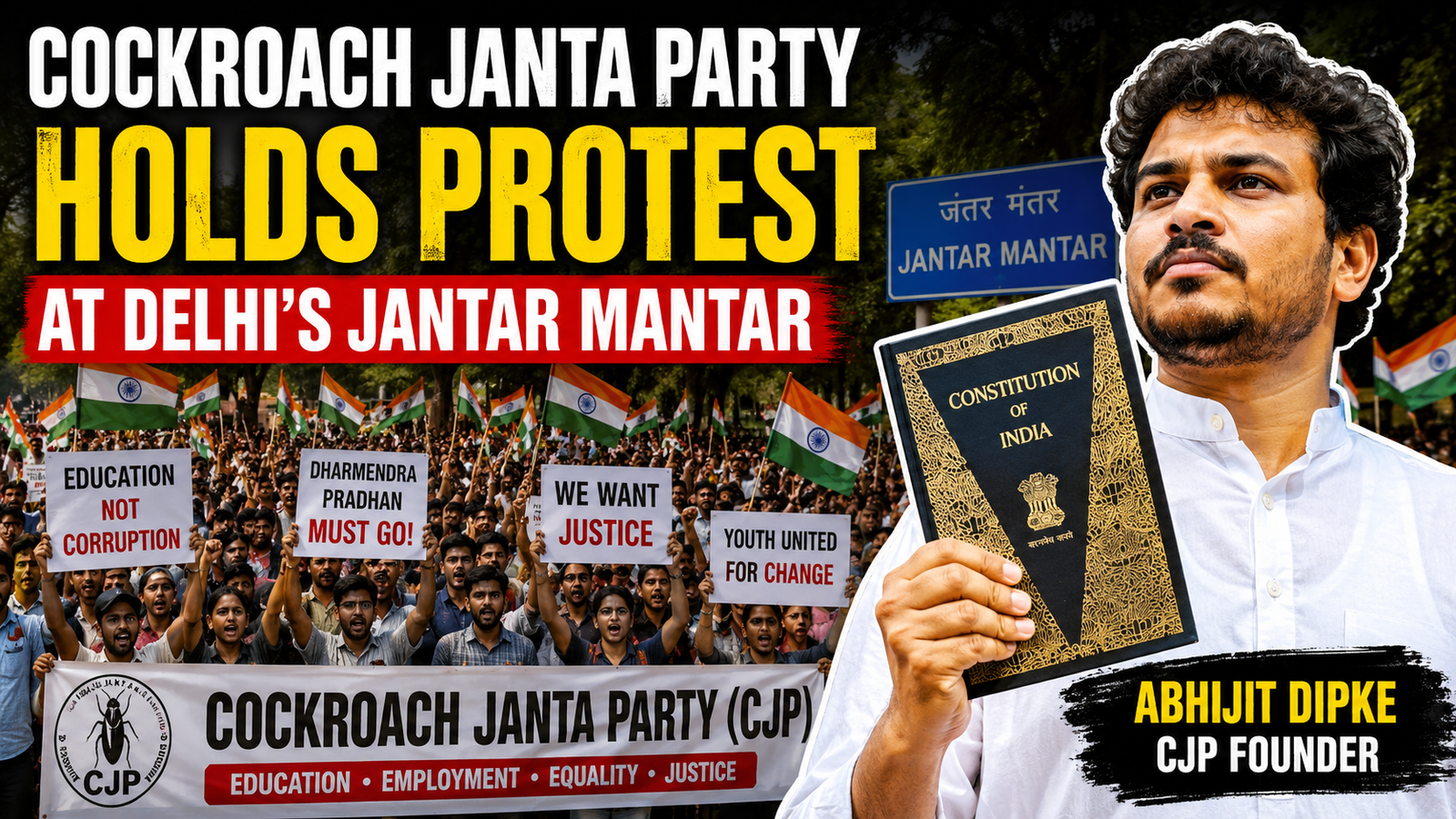
New Delhi witnessed a historic youth uprising on Saturday, June 6, 2026, as hundreds of supporters of the Cockroach Janta Party (CJP) descended on Jantar Mantar, India’s iconic protest ground, demanding the immediate resignation of Union Education Minister Dharmendra Pradhan over alleged irregularities in national examinations. Leading the charge was Abhijeet Dipke — the founder of CJP — who landed in Delhi this morning and marched straight to the protest site in what has quickly become one of the most talked-about youth movements in recent Indian political history.
Who Is Abhijeet Dipke and What Is the CJP?
To understand today’s protest, you first need to understand the extraordinary origin story of the Cockroach Janta Party (CJP).
CJP was founded on May 16, 2026, by Abhijeet Dipke — a political communications strategist who formerly worked with the Aam Aadmi Party. The movement emerged as a direct response to remarks made by the incumbent Chief Justice of India, Surya Kant, on May 15, 2026, in which he compared unemployed youth to “cockroaches” and “parasites of society.”
The Chief Justice’s words, spoken during a Supreme Court hearing, caused immediate outrage across social media. Rather than letting the insult pass, Dipke did something unexpected — he reclaimed it. The following day, Dipke announced the launch of a platform “for all the cockroaches out there,” listing eligibility as being unemployed, lazy, chronically online, and able to rant professionally.
What began as sharp political satire rapidly evolved into something far more serious: a well-organised, youth-driven accountability movement targeting examination irregularities, unemployment, and the failures of India’s education system.
Abhijeet Dipke Reaches Delhi: The Morning of June 6
The events of today moved quickly. Dipke landed in Delhi this morning and posted on X: “Landed. Looking forward to meeting you all at Jantar Mantar. Do not forget to carry a book and our Tiranga! Offer flowers to policemen as a gesture of compassion and gratitude. We have to lead this movement with love and peace!”

Dipke stepped out of the airport carrying a copy of B.R. Ambedkar‘s autobiography — a symbolic choice that was not lost on observers. He then headed to the Sansad Marg police station to formally request permission for the demonstration.
The Delhi Police ultimately granted Dipke permission for the demonstration at Jantar Mantar after police officials met him at the airport, and the CJP directed protesters to arrive directly at the site at 10 AM.
Jantar Mantar Comes Alive: What Happened at the Protest
Abhijeet Dipke, along with CJP spokesperson Ashutosh Ranka and others, joined the planned demonstration at Jantar Mantar amid heavy security. Hundreds of people — mostly young individuals — turned out for the demonstration, many of them wearing cockroach masks and holding flowers. School students were also seen attending the protest alongside their parents. The majority of participants were a mix of school and college students and young professionals.

The atmosphere, by multiple accounts, was peaceful, vibrant, and deeply charged with purpose. Protesters carried the national flag, books, and flowers — honouring Dipke’s call for a movement led by “love and peace.” The visual of youth with cockroach masks and marigolds handing flowers to police officers quickly went viral across social media platforms.
The protest was organised by the CJP, a youth-led online movement demanding accountability for alleged irregularities in examinations and recruitment tests, including NEET, CBSE, CUET, and SSC examinations.
The Core Demand: Resignation of Dharmendra Pradhan
At the heart of today’s protest is a single, non-negotiable demand — the resignation of Union Education Minister Dharmendra Pradhan.
The CJP holds Pradhan directly responsible for a pattern of alleged examination failures that have robbed millions of Indian students of fair opportunity. The list of grievances includes alleged irregularities and paper leaks in NEET (National Eligibility cum Entrance Test), CBSE examinations, CUET (Common University Entrance Test), and SSC (Staff Selection Commission) recruitment tests.
Education reformer and climate activist Sonam Wangchuk had earlier announced that he would also join the protest if Education Minister Dharmendra Pradhan did not step down by June 5. Wangchuk’s backing added significant weight to a movement that had already captured the national imagination.
Security, Preparation & the Scale of Response
The government took today’s protest seriously. More than 1,000 police officers were stationed in New Delhi ahead of the demonstration. Security was heightened across the national capital, with additional personnel deployed at Indira Gandhi International Airport, border entry points, and other sensitive locations.
The CJP, in a pointed social media post, shared a video of the extensive barricading set up around Jantar Mantar, writing: “Arrangements to stop cockroaches have been made completely tight.” The contrast between heavily armed state machinery and flower-carrying students in cockroach masks became one of the defining images of the day.
Why This Movement Matters
The CJP is not a conventional political party — it is registered with neither the Election Commission of India nor bound by any party manifesto. What makes it significant is precisely its unconventional nature: it is entirely youth-driven, digitally organised, satirically branded, and yet deadly serious in its demands.
In a country where millions of students spend years preparing for high-stakes competitive examinations — only to see alleged paper leaks, manipulation, and bureaucratic failure rob them of their future — the anger that propelled today’s protest at Jantar Mantar is entirely understandable. The CJP has given that anger not just a platform, but a symbol.
The cockroach — the insect the Chief Justice dismissed — has become a badge of honour for India’s frustrated, unemployed, and overlooked youth.
What Comes Next?
As of today, Dharmendra Pradhan has not responded to the resignation demand. The CJP has not announced whether further protests are planned, but the energy and momentum of today’s gathering suggests this movement is far from over.
For a movement that is barely three weeks old, the CJP’s ability to draw hundreds of people to Delhi’s streets — peacefully, symbolically, and with national media attention — marks it as one of the most remarkable youth political phenomena in recent Indian history.
The cockroaches, it seems, are not going anywhere.


