

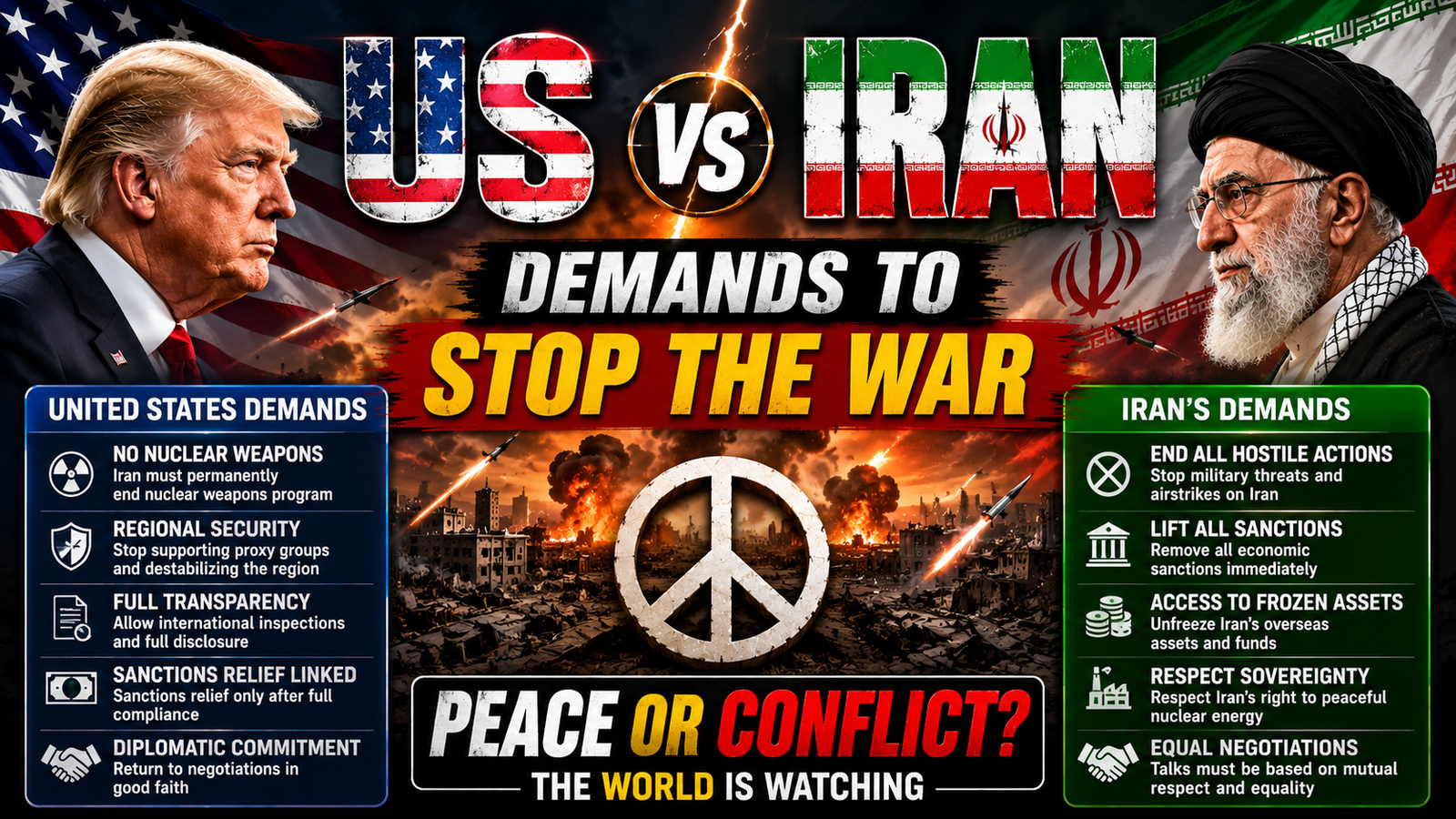
As US-Iran peace talks intensify in 2026, both sides have starkly different demands. From nuclear enrichment and the Strait of Hormuz to sanctions relief and proxy groups — here’s a full breakdown of what each side wants.
May 2026 — The war between the United States (alongside Israel) and Iran, which erupted on February 28, 2026, has triggered one of the most dangerous geopolitical crises of the decade. With Pakistan playing a key mediating role and talks shifting between Islamabad, Rome, and Geneva, both Washington and Tehran have laid out firm — and often conflicting — demands as the condition for ending hostilities. Here is a comprehensive breakdown of what each side is demanding at the negotiating table.
Background: How the War Started
The 2026 US-Iran conflict did not emerge overnight. It followed the breakdown of indirect nuclear negotiations that began in April 2025, after President Donald Trump sent a letter to Iran’s Supreme Leader Ali Khamenei setting a 60-day deadline for a nuclear agreement. When that deadline passed without a deal, Israel launched a series of strikes against Iran, with US backing, on February 28, 2026. The strikes killed Supreme Leader Ali Khamenei and targeted Iran’s nuclear and ballistic missile infrastructure. Iran retaliated by launching counter-strikes against Israel and US military bases in the region — and by closing the Strait of Hormuz, a critical global trade route through which roughly one-fifth of the world’s oil and gas supplies pass.
Since then, multiple rounds of peace talks have been held, most recently the fifth round in Rome in late May 2026, which ended without a breakthrough.
What the United States Is Demanding
1. Zero Nuclear Enrichment
The most non-negotiable demand from Washington is that Iran must completely halt uranium enrichment. Vice President JD Vance stated that the US “core goal” is Iran’s “affirmative commitment that they will not seek a nuclear weapon” or the tools to quickly build one. The Trump administration has pushed for what it calls “zero enrichment,” demanding that Iran dismantle key nuclear facilities at Natanz, Isfahan, and Fordow. Furthermore, the US — backed by Israeli Prime Minister Netanyahu — has insisted that all of Iran’s existing stockpile of near-weapons-grade enriched uranium (more than 400 kg) must be physically removed from Iranian soil and handed over to the International Atomic Energy Agency (IAEA).
2. A Long-Term Moratorium on Enrichment
Even in the more flexible framework being discussed as of May 2026, the US is demanding that any moratorium on uranium enrichment last for at least 20 years. Iran counter-proposed a 5-year moratorium, and a possible middle-ground of 12–15 years is being actively negotiated. The US also wants to insert a clause that any Iranian violation automatically extends the moratorium period.
3. End to Proxy Support and Terrorist Financing
A core US demand — highlighted in its 15-point proposal delivered to Tehran via Pakistan in March 2026 — is that Iran must stop funding, arming, and directing armed proxy groups across the Middle East. President Trump specifically stated that Iran must halt its financing of Hezbollah in Lebanon. The US also wants Iran to sever its support for Hamas and other allied militant organisations. This represents a significant expansion beyond the 2015 nuclear deal, which did not address proxy activities.
4. Ballistic Missile Programme Curbs
Washington has insisted that Iran’s ballistic missile programme — which can theoretically deliver nuclear warheads — must be restricted or dismantled as part of any comprehensive deal. This was a major sticking point even before the 2026 conflict began and remains a contentious issue in current negotiations.
5. Reopening of the Strait of Hormuz
The US is demanding that Iran lift its closure of the Strait of Hormuz, which has disrupted global energy markets and threatened to trigger a worldwide recession. A US naval blockade is currently in place in response to Iran’s closure. The US paused its “Project Freedom” escort operation in early May 2026, citing diplomatic progress, but has reserved the right to reinstate it if talks collapse.
What Iran Is Demanding
1. The Right to Enrich Uranium
Iran’s most absolute red line is its right to enrich uranium. Iranian officials have repeatedly stated that this is non-negotiable. Foreign Minister Abbas Araghchi has warned that demanding Iran give up enrichment entirely would “collapse the negotiations.” Iran argues that enrichment to 3.67% — the level permitted under the Non-Proliferation Treaty — is a sovereign right and was even allowed under the 2015 nuclear agreement. Tehran is willing to limit enrichment levels but not abandon the capability altogether.
2. Meaningful Sanctions Relief
Iran has demanded that any deal must deliver tangible and verifiable economic benefits. This includes the guaranteed lifting of US sanctions, the restoration of banking and trade ties with the international community, and the release of billions of dollars in frozen Iranian assets held in foreign banks — funds that have been locked up for years due to successive rounds of US sanctions. Iran insists that vague promises of sanctions relief — like those that soured the 2015 deal — are unacceptable.
3. Strait of Hormuz: End War First
In a key strategic position, Iran has argued that the Strait of Hormuz blockade issue must be resolved before any deeper nuclear negotiations begin. Tehran’s proposal, conveyed to the US via Pakistani mediators, focuses on ending the active war and reopening the strait as a first step — with nuclear talks to follow in a separate, structured process. Iran sees this sequencing as protection against losing its leverage once the hot war ends.
4. Recognition of Israel’s Nuclear Arsenal
Iranian officials have demanded that the international community — and the US specifically — acknowledge and address Israel’s undeclared nuclear arsenal as part of any broader regional security framework. Tehran views the double standard of nuclear scrutiny on Iran while Israel faces none as fundamentally unjust and has made this a recurring demand in multilateral settings.
5. Security Guarantees and No Regime Change
Having witnessed the assassination of Supreme Leader Khamenei in the February 2026 strikes, Iran’s new leadership is seeking credible security guarantees that the United States will not pursue regime change as a policy objective. Early in the conflict, President Trump suggested that only Iran’s “unconditional surrender” would be acceptable — a demand Iran categorically rejected. Any lasting deal will need to include assurances of Iran’s political sovereignty.
Where Do Talks Stand Today?
As of mid-May 2026, the two sides are closer to an agreement than at any previous point since the war began. Reports suggest that a one-page Memorandum of Understanding (MoU) is being finalised that would formally end the war and set the terms for a 30-day intensive negotiation period. The MoU is expected to include a moratorium on nuclear enrichment, a phased lifting of US sanctions, a release of frozen Iranian funds, and the gradual reopening of the Strait of Hormuz. However, significant gaps remain — particularly on the duration of the enrichment moratorium and the fate of Iran’s existing uranium stockpile. The fifth round of talks in Rome in late May ended without a final agreement, though both sides described the discussions as “constructive.”
The road to peace remains long. But with Pakistan mediating, global energy markets under strain, and both sides showing cautious flexibility, the world is watching closely for a breakthrough.
