



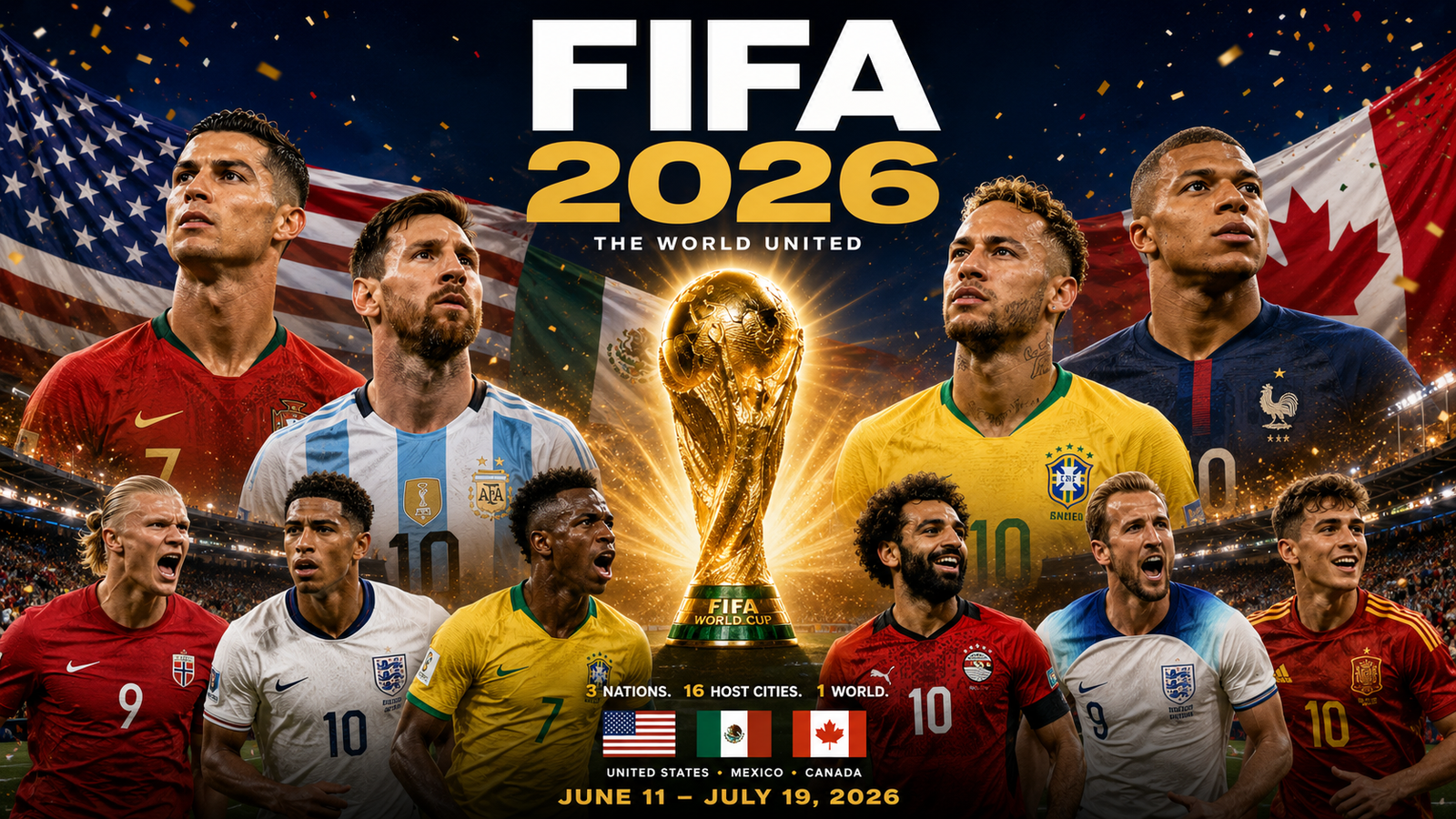
The FIFA World Cup 2026 has officially kicked off — and it is unlike any World Cup the world has ever seen. Bigger, longer, and spread across three countries for the first time ever, this tournament is rewriting the record books before a single trophy is lifted. Whether you’re a lifelong football fan or just getting into the World Cup buzz, here is everything you need to know.
How Many Teams Are Playing in FIFA World Cup 2026?
For the first time in history, the World Cup features 48 national teams — a massive jump from the 32-team format that had been used since 1998. This expansion makes the 2026 edition the largest World Cup ever held, growing from 32 to 48 national teams.
The teams are divided into 12 groups of four, and each team plays three group-stage matches. The top two teams in each group advance to the knockout stage, along with the eight best third-place teams.
Among the most notable newcomers, four national teams — Cape Verde, Curaçao, Jordan, and Uzbekistan — are making their World Cup debuts this year
How Long Will the Tournament Last?
This is the longest World Cup in history. Because of the larger number of participants, the 2026 World Cup will last 39 days instead of the roughly 32 days of previous tournaments.
Here are the key dates:
- Opening Match: Thursday, June 11, 2026
- Final: Sunday, July 19, 2026
- Total Duration: 39 days
- Group Stage: June 11 to June 27
The opening match took place at Estadio Azteca in Mexico City, where Mexico faced South Africa — though South Korea was also reported as an opening-day opponent in some schedules, reflecting last-minute fixture confirmations.
Where Is the FIFA World Cup 2026 Being Held?
For the first time in World Cup history, three countries are jointly hosting the tournament: it is the first time that three countries are jointly hosting a World Cup and only the second time that more than one country has done so, after Japan and South Korea co-hosted the 2002 World Cup.
The host nations are:
- 🇺🇸 United States — 11 host cities
- 🇲🇽 Mexico — 3 host cities
- 🇨🇦 Canada — 2 host cities
The U.S. host cities are Los Angeles, Miami, Atlanta, Seattle, Houston, Philadelphia, Kansas City, Boston, Dallas, the San Francisco Bay Area, and the New York City metropolitan area. The host cities in Mexico are Guadalajara, Mexico City, and Monterrey; and the host cities in Canada are Toronto and Vancouver.
Key Venues to Know:
- Opening Match: Estadio Azteca, Mexico City — the first stadium to host games at three different men’s World Cups
- Final: MetLife Stadium, New Jersey
- Semifinals: AT&T Stadium (Dallas) and Mercedes-Benz Stadium (Atlanta)
- Third-Place Match: Miami
Tournament Format: How the 48-Team World Cup Works
The new 48-team format introduces extra excitement with an additional knockout round. The tournament consists of a total of 104 matches — 72 in the group stage and 32 in the knockout stage.
The knockout stages now include a brand-new Round of 32 — a stage that did not exist in the 32-team format — giving more nations the chance to experience knockout football and earn bigger prize money.
Record-Breaking Prize Money: $727 Million Pool
This year’s World Cup isn’t just the biggest by team count — it’s also the richest in history. FIFA confirmed that a total of $727 million would be paid out to teams, representing a 50 percent increase on the total prize fund paid out at the 2022 World Cup in Qatar.
Here’s the full prize money breakdown per finishing position:
| Finish | Prize Money |
|---|---|
| 🏆 Champions | $50 million |
| 🥈 Runners-up | $33 million |
| 🥉 3rd Place | $29 million |
| 4th Place | $27 million |
| 5th–8th Place | $19 million |
| 9th–16th Place | $15 million |
| 17th–32nd Place | $11 million |
| 33rd–48th Place | $9 million |
Additionally, FIFA pays each of the 48 qualified nations a $2.5 million preparation fee before a ball is kicked, meaning the true minimum any team earns simply for qualifying is $12.5 million — a World Cup record for minimum payout.
Later reports revealed the figure climbed even higher: FIFA increased total distribution to participating teams to $871 million, making it the most lucrative edition on record, following criticism over ticket pricing and commercial partnerships.
The Official Match Ball: Adidas Trionda
Every World Cup has an iconic ball, and 2026 is no exception. The Adidas Trionda has been selected as the tournament’s official match ball, featuring a design that represents the three host nations — United States, Canada, and Mexico — and incorporates the latest FIFA technology.
The Pro Version, priced at $170, is the edition that will actually be used at the 2026 World Cup, featuring premium materials and a “connected-ball” sensor used for VAR decisions. Budget versions for fans start as low as $25.
7. Who Are the Favourites to Win?
With Argentina entering as defending champions, the betting markets paint an interesting picture. Spain and France are co-favorites at most books, priced in the +450 to +500 range, with England, Brazil, and defending champion Argentina rounding out the top five on the outright winner board.
History suggests caution for the title-holders, though: three of the last four title holders — Italy in 2010, Spain in 2014, and Germany in 2018 — crashed out at the group stage.
For host nations, the omens are mixed but not hopeless. Hosts have won the tournament 6 of 22 times historically, and home pitch advantage has been measured at roughly half a goal of differential in match play.
Bonus: Things You Might Be Missing
A few additional details that make this World Cup truly historic:
- Temporary Stadium Conversions: Several NFL stadiums are being temporarily adjusted for soccer, including pitch and branding changes — a logistical feat never attempted at this scale.
- Ticket Price Controversy: The tournament has faced significant backlash over ticket pricing. Tickets for the tournament in the United States, Canada, and Mexico are up to five times more expensive for fans than they were in 2022, although FIFA was forced to cut prices for a small number of tickets to $60 following the backlash.
- Travel Planning Tip: If you’re planning to attend multiple matches, group host cities geographically. Grouping nearby host cities can reduce unnecessary long-distance transfers — West: Vancouver, Seattle, San Francisco Bay Area, and Los Angeles; Central and Mexico: Dallas, Houston, Kansas City, Monterrey, Guadalajara, and Mexico City; East: Toronto, Boston, New York/New Jersey, Philadelphia, Atlanta, and Miami.
- Qualification Drama: Ahead of the final draw in December 2025, 42 countries had already qualified for the tournament, with the final 6 qualifying spots decided through playoffs in March 2026.
Final Whistle: Why FIFA World Cup 2026 Matters
This is more than just a football tournament — it’s a once-in-a-generation global event. With 48 teams, 104 matches, 16 host cities across 3 countries, a 39-day schedule, and a record $871 million prize pool, the 2026 World Cup is bigger, longer, richer, and more ambitious than anything FIFA has ever organised.
Whether your team is a footballing powerhouse or a thrilling debutant like Cape Verde or Jordan, one thing is certain — football fans around the world are in for the ride of a lifetime.
READ MORE : Terafab Intel Partnership


