



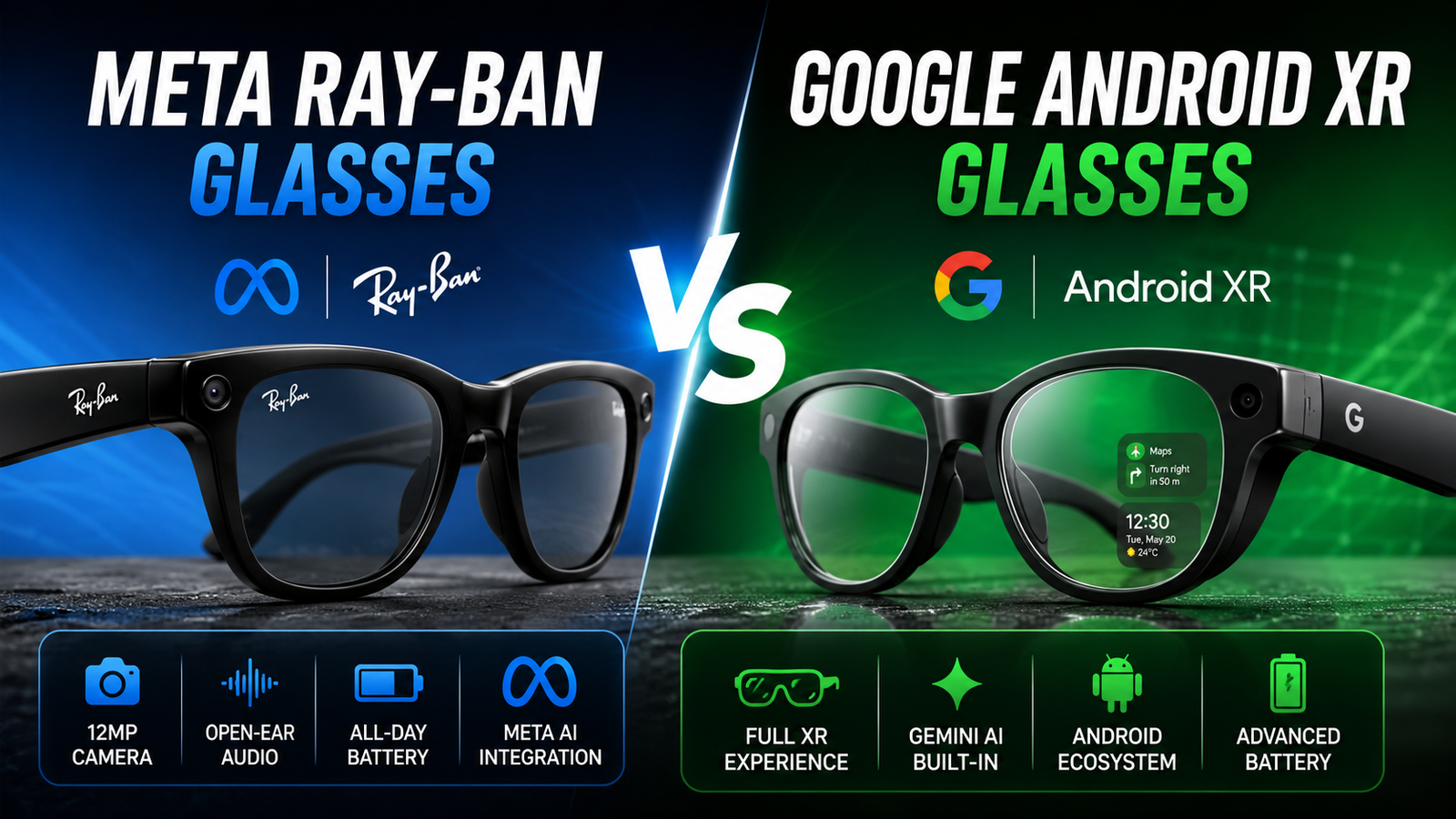
The smart glasses revolution is no longer a concept — it is happening right now, and two technology giants are leading the charge in two dramatically different directions. Meta’s Ray-Ban AI glasses have already sold over seven million units, making them one of the most successful consumer wearables in recent history. Now, Google and Samsung’s Android XR glasses are preparing to enter the arena, powered by Gemini AI, with a Fall 2026 launch on the horizon.
But which pair deserves a place on your face? This in-depth comparison breaks down every key difference — from design and AI features to display, price, and ecosystem — so you can decide which is the right investment for you.
At a Glance: Meta Ray-Ban Glasses vs Google Android XR Glasses
Meta Ray-Ban glasses are the result of a long-running partnership between Meta and EssilorLuxottica. Already in their second generation, they combine the iconic styling of Ray-Ban and Oakley frames with built-in cameras, Meta AI, speakers, and — in the premium Display model — a heads-up display (HUD) powered by the Meta Neural Band.
Google Android XR glasses are a collaboration between Google and Samsung, with frames designed by fashion-forward eyewear brands Gentle Monster and Warby Parker. They run Google’s brand-new Android XR operating system with Gemini AI at the core — and represent Google’s most serious re-entry into smart eyewear since the much-maligned Google Glass era.

1. Design & Fashion Partnerships
Meta Ray-Ban: Meta’s biggest early advantage was convincing consumers that smart glasses could actually look good. The Ray-Ban partnership delivered that, and the second generation expanded the lineup significantly. New Gen 2 styles — Blayzer (rectangular) and Scriber (rounded) — are built specifically for prescription lens users, with overextension hinges, interchangeable nose pads, and optician-adjustable temple tips for all-day comfort. Oakley Meta HSTN and Vanguard models also cater to sport and lifestyle users.
Google Android XR: Google is matching Meta’s fashion strategy blow for blow. The Android XR glasses come in styles designed by Gentle Monster — known for its bold, disruptive aesthetics — and Warby Parker — known for its refined, timeless designs. A luxury Gucci collaboration is also confirmed for 2027. This multi-brand, multi-price-point approach mirrors Meta’s playbook while offering a more diverse style portfolio out of the gate.
Verdict: Both offer genuine fashion credibility. Meta wins on availability; Google wins on style range.
2. AI Assistant: Meta AI vs Gemini
This is where the two glasses most sharply diverge in philosophy.
Meta Ray-Ban runs Meta AI — accessible via the “Hey Meta” wake word, with no need to repeat it between follow-up questions. The AI handles real-time object recognition, location awareness, live translation, phone call captioning, and Instagram Reels playback on the Display model. It integrates with WhatsApp and Messenger for hands-free messaging.
Google Android XR glasses are powered by Gemini — Google’s most advanced AI model. Gemini enables turn-by-turn navigation, real-time translation, restaurant ordering assistance, calendar additions, summarised smart notifications, and a feature called “Memory” — which helps users recall where they last left objects or what they previously looked at. For anyone already deep in Google’s ecosystem — Gmail, Maps, Calendar, Search — this integration will feel remarkably natural.
Verdict: Meta AI is more mature and feature-complete today. Gemini is broader, deeper, and better integrated with daily productivity tools — giving it the higher ceiling.
3. Display Technology
Meta Ray-Ban Display: The premium Ray-Ban Display model features an in-lens heads-up display with a peak brightness of 5,000 nits — bright enough to remain clearly visible in direct sunlight, solving one of the fundamental challenges that has plagued smart eyewear for years. The display supports navigation, notifications, captions, Instagram Reels, and even games.
Google Android XR: Google’s glasses are confirmed to feature a display — reportedly visible in the right lens only by design — along with a 70-degree field of view, which is significantly wider than what Meta currently offers. The wider FOV promises a more immersive, natural AR experience.
Verdict: Meta’s 5,000-nit display is sunlight-readable and proven. Google’s wider 70-degree FOV promises a more immersive experience — if it delivers in real-world use.
4. Chipset & Hardware
Meta Ray-Ban: Powered by a Qualcomm Snapdragon AR chipset with Wi-Fi 6 connectivity, the Gen 2 glasses offer strong, reliable performance with improved audio through upgraded microphones and speakers. The newer FCC-filed models (codenamed Blazer and Scriber, model numbers RW7001 and RW7002) use Wi-Fi 6 U-NII-4 (5.9GHz), indicating a next hardware generation is already in the pipeline.
Google Android XR: Google’s glasses combine an Xreal X1S chip and a Qualcomm Snapdragon chip — a dual-chip architecture designed to distribute the processing load between the AI workload and the display/sensor pipeline. This is a notably ambitious hardware configuration for a pair of glasses.
Verdict: Google’s dual-chip architecture is more powerful on paper. Meta’s hardware is proven, shipping, and polished.
5. Unique Features You Won’t Find on the Other
Meta Ray-Ban exclusive features:
- Meta Neural Band — a wristband that detects subtle finger movements for hands-free control, scrolling, and virtual handwriting (now in Early Access)
- Hands-free nutrition tracking — point at food and get instant nutritional information
- Meta AI WhatsApp message summaries
- Instagram Reels playback on the Display model
- Find device feature via the Meta AI app
Google Android XR exclusive features:
- Gemini Memory — the glasses remember what you’ve seen and where you’ve been, helping you find lost items or recall earlier interactions
- Full Android XR ecosystem — access to the same app ecosystem across phones, tablets, headsets, and glasses
- Cross-device continuity — take a photo with your glasses and instantly view it on your smartwatch
- Deep Google Search integration — scan a book or product and get instant context from Google’s knowledge graph
6. Price
Meta Ray-Ban: Starts at $299 for standard AI glasses. The Display model with HUD launched at $799. The new Blayzer Optics and Scriber Optics prescription-ready models start at $499.
Google Android XR: Pricing has not been officially confirmed. Based on the hardware specifications and the dual-chip architecture, analysts expect a starting price in the $300–$500 range to remain competitive with Meta — though some reports suggest a high-end display-equipped variant could approach $1,000.
Verdict: Meta offers a clear, tiered pricing structure today. Google’s pricing remains uncertain but is expected to be competitive.
7. Availability & Ecosystem
Meta Ray-Ban: Available now in the US, with international expansion to Canada, France, Italy, and the UK planned for early 2026. Works with both Android and iOS devices.
Google Android XR: Confirmed for Fall 2026 — additional details on exact launch date and full availability are expected in the coming months. Designed primarily as a companion to Android smartphones, with deep integration into Google’s app and services ecosystem.
Verdict: Meta wins on availability. Google wins on long-term ecosystem depth for Android users.
Side-by-Side Comparison
| Feature | Meta Ray-Ban (Gen 2) | Google Android XR |
|---|---|---|
| AI Assistant | Meta AI | Gemini |
| Display Brightness | 5,000 nits HUD | Display (FOV 70°) |
| Field of View | Standard | 70 degrees |
| Chipset | Qualcomm Snapdragon AR | Xreal X1S + Qualcomm Snapdragon |
| Fashion Partners | Ray-Ban, Oakley | Gentle Monster, Warby Parker, Gucci |
| Neural/Gesture Control | Meta Neural Band | Voice + gesture |
| Prescription Support | ✅ Yes (Blayzer, Scriber) | TBC |
| iOS Compatible | ✅ Yes | Primarily Android |
| Starting Price | $299 | ~$300–$500 (estimated) |
| Availability | Available now | Fall 2026 |
Final Verdict: Which Should You Buy?
Choose Meta Ray-Ban if: You want smart glasses right now, value a proven AI ecosystem, use Instagram and WhatsApp heavily, prefer iOS compatibility, and want a clear, tiered choice across price points.
Choose Google Android XR if: You are an Android power user, live inside Google’s ecosystem of Maps, Gmail, and Calendar, want Gemini’s deeper AI capabilities, and are happy to wait until Fall 2026 for the most advanced smart glasses yet built.
The smart glasses war of 2026 is only just beginning — and for consumers, that is very good news indeed. Both Meta and Google are pushing the boundaries of what a pair of glasses can do, and the competition between them will only make both products better, faster, and more affordable over time.
The future is on your face. The only question is whose logo is on the temple.
read more : microsoft surface laptop with nvidia rtx spark


